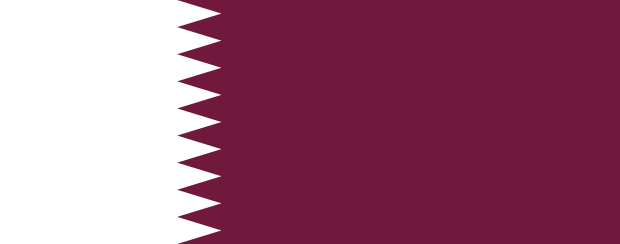
Qatar

Flag is available in resolutions
![]() |
![]() |
Qatar
Qatar, a small but strategically significant nation nestled on the northeastern coast of the Arabian Peninsula, projects an outsized influence on the global stage, largely attributable to its immense natural gas reserves. Bordered by Saudi Arabia to the south and the Persian Gulf surrounding its other three sides, this peninsular country has transformed from a humble pearl-diving and fishing economy into one of the world’s wealthiest states, characterized by rapid modernization and ambitious development. Its unique blend of ancient Bedouin traditions and futuristic aspirations makes it a fascinating subject for study, embodying the dramatic shifts occurring across the Gulf region.
Geographically, Qatar is predominantly flat and arid, a low-lying desert landscape punctuated by sparse vegetation in wadis and along the coast. Its highest point, Qurayn Abu al Bawl, stands at a mere 103 meters. The country’s coastline stretches for approximately 563 kilometers, featuring sandy beaches, coral reefs, and shallow waters that have historically supported its maritime industries. The climate is characterized by scorching summers, with temperatures frequently exceeding 40°C, and mild winters. Rainfall is scarce and irregular, leading to a reliance on desalination for freshwater. Doha, the vibrant capital city, is situated on the east coast and serves as the nation’s economic, cultural, and political hub, showcasing an impressive skyline of modern skyscrapers. This challenging natural environment has necessitated innovative engineering solutions and sustainable practices to support its burgeoning population and economy.
The history of Qatar is a rich tapestry woven with threads of ancient settlements, regional rivalries, and eventual independence. Archaeological evidence suggests human habitation dating back to the Stone Age. For centuries, the region was primarily inhabited by nomadic Bedouin tribes and small fishing communities, with pearl diving being the primary economic activity. The Al Thani family, originally from the Najd region, established their rule in the mid-19th century, consolidating power and laying the foundations for the modern state. The early 20th century saw the decline of the pearl industry due to the advent of cultured pearls, plunging the region into economic hardship. However, the discovery of vast oil reserves in 1939 and, more significantly, massive natural gas fields in the 1970s, completely reshaped Qatar’s destiny. It became a British protectorate in 1916 and gained full independence on September 3, 1971, subsequently joining the United Nations and embarking on a path of rapid development under the continued leadership of the Al Thani dynasty.
Demographically, Qatar presents a striking picture of a nation with a small indigenous population and a substantial expatriate workforce. The total population is approximately 2.8 million, but Qatari citizens constitute only about 10-15% of this figure, numbering around 300,000. The vast majority of residents are foreign workers, primarily from South Asian countries like India, Nepal, Bangladesh, and the Philippines, alongside significant numbers from other Arab nations, Europe, and North America. This demographic imbalance results in a highly skewed male-to-female ratio. Islam is the official religion, and Sharia law forms the basis of its legal system, though applied with leniency in many civil matters. Arabic is the official language, but English is widely spoken and understood, particularly in business and among the expatriate community. The government has invested heavily in education and healthcare to improve the quality of life for all residents, though concerns regarding migrant worker rights have drawn international scrutiny.
Economically, Qatar is an undisputed global powerhouse, primarily driven by its colossal reserves of natural gas. It holds the world’s third-largest proven natural gas reserves and is a leading exporter of Liquefied Natural Gas (LNG), making it a critical player in global energy markets. Oil production also contributes significantly to its wealth. This immense hydrocarbon wealth has endowed Qatar with one of the world’s highest GDP per capita figures. Recognizing the finite nature of fossil fuels, the nation has embarked on an ambitious diversification strategy outlined in its Qatar National Vision 2030. This plan aims to transform Qatar into an advanced society capable of sustaining its development and providing a high standard of living for its people. Key pillars of this diversification include investments in education (through initiatives like Education City), healthcare, tourism, finance, and technology. The Qatar Investment Authority (QIA), the country’s sovereign wealth fund, manages vast assets globally, further solidifying its economic influence and securing its financial future beyond hydrocarbons.
The political landscape of Qatar is an absolute monarchy, with the Al Thani family having ruled since the mid-19th century. The current head of state is the Emir, Sheikh Tamim bin Hamad Al Thani, who exercises ultimate executive and legislative authority. While there is a consultative assembly, the Shura Council, its powers are limited. Qatar has pursued an independent and often assertive foreign policy, seeking to mediate regional conflicts and foster diplomatic relations across the globe. It hosts the influential news network Al Jazeera, which has played a significant role in shaping public discourse in the Arab world and beyond. The nation’s strategic location and financial might have allowed it to forge strong alliances and play an increasingly prominent role in international affairs.
Culturally, Qatar remains deeply rooted in Islamic traditions and Bedouin heritage, yet it embraces modernity with an open mind. Hospitality, generosity, and respect for elders are core values. The majlis, a traditional gathering space, remains central to social life and community engagement. While traditional dress is common, particularly among Qatari men (wearing the thobe) and women (wearing the abaya), Western influences are also evident, especially in urban areas. The government has made substantial investments in cultural institutions, such as the Museum of Islamic Art and the National Museum of Qatar, to preserve and promote its heritage while also fostering contemporary arts. The nation’s commitment to sports, culminating in hosting the FIFA World Cup 2022, showcased its organizational capabilities and its desire to connect with the global community, despite the various controversies surrounding the event.
In conclusion, Qatar stands as a testament to the transformative power of natural resources combined with strategic vision and ambitious leadership. From its humble origins as a pearl-diving outpost, it has evolved into a sophisticated, globally connected nation. While facing challenges such as climate change, the need for continued economic diversification, and ongoing scrutiny over human rights, Qatar’s trajectory points towards a future where it continues to leverage its wealth and influence to secure its prosperity, maintain its unique cultural identity, and play a significant role in regional and international affairs. Its journey exemplifies the dynamic interplay between tradition and progress in the modern Middle East.
Information about Qatar
The information comes from the publication CIA The World Factbook.
Automated text translation, excuse errors, please!
Country Qatar is situated in a location / continent Middle East. Qatar has an area of 11 586 km2 and 1 951 591 residents. The highest point has a height 103 above sea level. and it is called Qurayn Abu al Bawl. The lowest point is located at the level of 0 above sea level and it is named Persian Gulf. System of government is Emirate and the date of independence Third September 1971. The capital city is Doha. Qatar has the international abbreviation QA.
Recommended to visit: Vlajka Panamy
Qatar - economy
Total gross domestic product (GDP) is 184 300 000 000 $. Total gross domestic product per capita in purchasing power parity is 104 300 $. GDP grows by 18.80 % a year. Inflation (consumer price index) is equal to 1.90 % a year. Qatar have 1 241 000 working-age population (from a total population 1 951 591 people). Unemployment is at 0.40 %. Qatar issued 2.50 % GDP to healt care and 10,00 % GDP to army. The public debt of the country is 33.10 % GDP. The total amount of foreign debt is 125 300 000 000 USD.
Qatar - demography
As suggested above, Qatar has 1 951 591 people. Population growth is in the amount 4.93 % per year. Number of children born per 1000 population per year is 10.23.Every mother has average 1.93 children. The infant mortality rate is 6.81 and maternal mortality 7.00 deaths per 100,000 births. Average estimated life expectancy makes 78.09 years. Mortality is 1.55 people per 1000 population per year.
Qatar - transport and telecommunications
Qatar has 7 790 km of roads and 6 airports. There is registered 28 ships.
Number of active mobile phones (sim card) in the country Qatar is 2 302 000. Number of active fixed telephone lines is 306 700. Qatar has 563 800 internet users, who have the available 887 Internet connections. Qatar has been assigned a domain first Choose range .qa.
Qatar - energetics
Qatar consumes a year 17 330 000 000 kWh of electricity. Annual electricity production is 22 280 000 000 kWh in power plants with a total installed electrical capacity 3 893 000 kW. Qatar exports 0 kWh and imports 0 kWh of electricity per year Energy mix of power generation is as follows: fossil fuels: 100 %, nuclear energy: 0 %, renewable: 0.0 %, hydropower: 0.0 %. The country Qatar is harvested annually 1 631 000 barrels of oil.
World countries flags
Omalovánky pro děti:
Online omalovánky aut a autíček zdarmaObrázky budov a staveb online k vybarvení
Online omalovánky dinosauři
Online omalovánky dopravních prostředků
Obrázky koní online k vybarvení pro děti
Počítačové, internetové online omalovánky
Pohádkové postavy online k vybarvení
Obrázky povolání a zaměstnání lidí k vybarvení
Online omalovánky princezny k vybarvení
Příroda - obrázky k vybarvení na počítači
Omalovánky psi pro děti online k vybarvení
Online omalovánky roztomilých zvířatek
Vánoční, adventní online omalovánky zdarma
Velikonoční online omalovánky pro děti zdarma
Online omalovánky, obrázky vlaků k vybarvení
Textová přání k narozeninám:
Narozeninový text pro ženuNarozeninové texty pro muže
Narozeninové blahopřání sms
Blahopřání k narozeninám podle jmen
Texty z lásky k narozeninám
Gratulace k svátku:
Blahopřání k svátku pro mužePřáníčka k jmeninám podle jmen
Přání k svátku sms
Přání k jmeninám pro děti
Přáníčko k svátku pro kamarádku
Texty k svátku podle jmen
|
|
|
|
|
|
|
|
|
|
|
|
|
|
|

|
|
|
|
|
|

|
|

|

|
|
|
|